
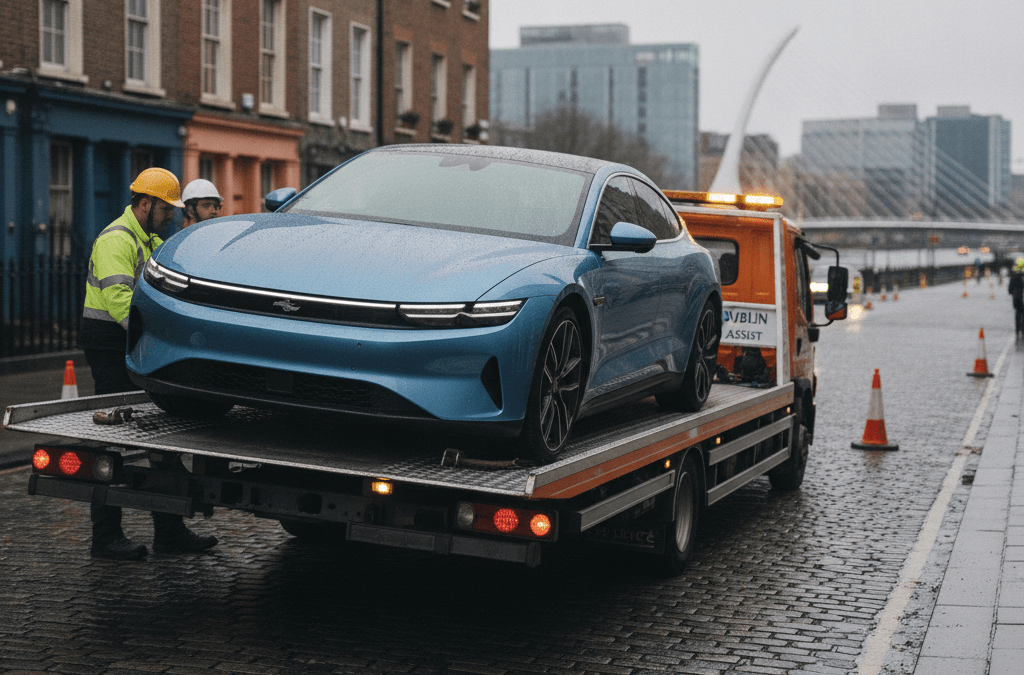
Electric cars are now a common sight across Dublin, from city-centre commuters and taxi drivers to families using EVs for school runs, shopping trips and weekend journeys. For most drivers, the day-to-day experience is simple: charge at home or at a public charger, drive quietly, and enjoy lower running costs. But when something goes wrong, an electric vehicle breakdown can feel very different from a petrol or diesel problem.
If your EV runs out of charge, refuses to start, shows a high-voltage warning, gets a puncture, or becomes stuck in park, the next steps matter. Electric cars are heavy, technically different, and in many cases cannot be towed in the same way as conventional vehicles. The wrong recovery method can cause drivetrain damage, battery system issues or safety risks. That is why EV drivers in Dublin should know what to do before a breakdown happens, and why it is important to call a recovery operator who understands electric vehicles.
This guide explains what to do if your electric car breaks down in Dublin, how EV roadside assistance differs from standard car recovery, when a flatbed tow truck may be needed, and what information you should give when calling for help. If you are comparing general towing situations as well, CC Recovery also has a detailed guide to car towing in Dublin and Ireland, including the process and practical cost factors for drivers.
Common Reasons Electric Cars Break Down in Dublin
EVs have fewer moving parts than petrol or diesel cars, but they are not immune to breakdowns. In fact, some EV problems are unique because the vehicle depends on multiple electrical systems working together. A breakdown might be caused by a completely flat high-voltage battery, a faulty 12-volt battery, a charging issue, a tyre problem, a software fault, a collision, or a warning that prevents the car from being driven.
In Dublin, location can make the situation more stressful. Running out of charge on the M50 is very different from stopping outside your home in Rathmines or in a multi-storey car park near the city centre. Narrow streets, bus lanes, restricted loading areas and underground car parks can all affect the safest recovery method. The first priority is always to keep yourself, your passengers and other road users safe before thinking about the car itself.
Running Out of Charge
The most obvious EV breakdown is a flat main battery. Modern electric cars give plenty of warnings before reaching zero, but range estimates can change quickly in cold weather, heavy traffic, motorway driving, rain, heating use or when carrying extra passengers and luggage. A charger may also be occupied, faulty, blocked or incompatible when you arrive, leaving you without enough charge to continue.
If your EV is still moving and showing very low range, do not gamble on reaching a distant charger. Aim for the nearest safe stopping place, such as a service area, car park or quiet side road. If the car loses power, use hazard lights if possible and move away from live traffic. Once stopped, avoid repeatedly trying to restart the vehicle if the system warns that the battery is depleted.
12-Volt Battery Failure
Many EV owners are surprised to learn that electric cars still have a 12-volt battery. This smaller battery powers control modules, locks, lights and the systems that allow the main high-voltage battery to engage. If the 12-volt battery fails, the car may appear completely dead even if the main battery has plenty of charge. Doors may not unlock normally, the dashboard may not wake up, or the vehicle may refuse to shift out of park.
Some 12-volt issues can be resolved at the roadside, depending on the vehicle and access points. However, drivers should not assume that jump-starting an EV is identical to jump-starting a conventional car. Always follow the owner’s manual and avoid connecting equipment to high-voltage components. If in doubt, call for assistance and explain that the vehicle is electric and may have a 12-volt battery problem.
Tyres, Suspension and Collision Damage
Electric vehicles are often heavier than similar petrol or diesel cars because of their battery packs. That weight can affect tyre wear, puncture repairs and recovery choices. Many EVs do not carry a spare wheel, instead relying on sealant kits or run-flat tyres. If a tyre is badly damaged, if the wheel is cracked, or if the suspension has been affected by a kerb or pothole, the car may need recovery rather than a roadside fix.
After a collision, even a minor one, extra care is needed. A visible scrape does not automatically mean the high-voltage battery is damaged, but warning lights, unusual smells, smoke, fluid leaks, heat, or damage near the underside of the vehicle should be treated seriously. Keep a safe distance and tell the recovery operator exactly what happened.
What to Do Immediately If Your EV Breaks Down
The first few minutes after a breakdown are important. Your actions should be calm, practical and focused on safety. If the vehicle is still able to move, steer it to the safest available place. On a motorway or major route, try to reach a hard shoulder, emergency refuge area or safe exit. In the city, avoid stopping on bends, junctions, tram tracks, bus lanes or narrow streets where possible.
- Switch on hazard lights as soon as it is safe to do so.
- Put on a high-visibility vest if you have one and it is safe to leave the vehicle.
- Move passengers away from traffic, behind a barrier where possible.
- Do not stand between your vehicle and moving traffic.
- Check the dashboard message and note any warning symbols.
- Call for EV-capable breakdown recovery and provide your exact location.
If you are in a dangerous position, such as a live lane, a blind bend, a tunnel approach or a fast-moving section of road, treat it as an urgent safety situation. Do not spend time trying to diagnose the fault at the roadside. Once everyone is safe, you can gather the information the recovery team needs.
Why EV Towing Instructions Matter
One of the biggest differences between electric car recovery and traditional car recovery is towing procedure. Many EVs should not be towed with their driven wheels on the ground. Depending on the model, rolling the wheels while the car is off can rotate electric motors and drivetrain components in a way the manufacturer does not allow. Some vehicles also have specific limits for towing speed, distance and wheel position.
This is why the owner’s manual matters. Manufacturers usually provide a section on transport, breakdown towing or emergency recovery. It may explain how to activate transport mode, neutral mode, tow mode, service mode or a manual park release. It may also state whether the vehicle must be lifted fully off the ground. In many cases, the safest option is a flatbed recovery truck, especially if the car cannot be placed into neutral or if the fault is unknown.
Trying to drag an EV onto a truck while it is locked in park can damage tyres, brakes or driveline components. Towing it behind another vehicle on a rope or strap is also generally unsuitable and unsafe on public roads. A professional recovery operator will assess how to load the car without forcing the wheels to turn incorrectly, and will use the correct equipment for the vehicle’s condition and location.
Flatbed Recovery Is Often the Best Option
A flatbed recovery truck carries the vehicle with all four wheels off the road. For many EV breakdowns, this is the preferred approach because it reduces the risk of drivetrain damage during transport. It is especially useful when the car has no power, will not select neutral, has accident damage, has a severe tyre issue, or needs to be moved from a motorway or busy urban location.
Not every EV situation is identical. Some models can be moved short distances using specific manufacturer procedures, while others require strict flatbed transport. The key point is that towing decisions should be based on the vehicle’s instructions, not guesswork. If you are unsure, tell the operator the make, model, year and dashboard warning message so they can prepare properly.
Roadside Assistance vs Breakdown Recovery for EVs
EV drivers often use the terms roadside assistance and breakdown recovery interchangeably, but they are not the same. Roadside assistance usually means trying to solve the issue where the vehicle has stopped. Breakdown recovery means transporting the vehicle to another location, such as your home, a garage, a dealer, a charger or a safe storage point.
For electric cars, the distinction can be important. A minor 12-volt battery issue might be handled at the roadside. A puncture may be resolved if the tyre can be safely repaired or inflated. But a depleted high-voltage battery, charging system fault, immobilised vehicle or high-voltage warning may require transport. For a broader explanation of how these services differ, see CC Recovery’s guide to breakdown recovery vs roadside assistance.
Mobile charging is sometimes discussed as a solution for flat EVs, but availability varies and it may not be practical in every situation. In many real-world Dublin breakdowns, recovering the vehicle to a working charger or safe destination is the more reliable option. This is particularly true if the vehicle has stopped in a dangerous place, if the nearest charger is not suitable, or if the car will not accept charge due to a fault.
What Information to Give When Calling for EV Recovery
The more accurate your information, the easier it is to send the right help. Before calling, check your location using a map app if possible. In Dublin, street names can be confusing, and a nearby landmark, junction, car park level, eircode or motorway marker can save time. If you are in an underground car park or apartment basement, mention height restrictions because they may affect the recovery vehicle that can access you.
- Make, model and year of the electric vehicle.
- Whether it is fully electric or plug-in hybrid.
- Current location and any access restrictions.
- Whether the car powers on and can select neutral.
- Dashboard warning messages or fault codes shown.
- Battery percentage or estimated range, if available.
- Whether there is collision damage, smoke, fluid leakage or unusual heat.
- Your preferred destination: home, charger, garage or dealer.
If you have the owner’s manual in the car or on your phone, keep it available. The recovery operator may ask you to check the section on transport mode, towing eye location, wheel chocks, manual release points or alarm settings. Do not crawl under the vehicle or remove panels unless you are clearly instructed and it is safe to do so.
Practical Dublin Scenarios for EV Drivers
Scenario 1: You Run Out of Charge Near the M50
You are driving home after a long day and the range estimate drops faster than expected. The nearest charger is busy, and the car stops before you reach the next exit. In this situation, your priority is not charging the car where it sits; it is getting everyone away from traffic and arranging safe recovery. A flatbed truck may be used to move the EV to a suitable charger or home address, depending on access and your preference.
Scenario 2: Your EV Is Dead in an Apartment Car Park
Your car has plenty of main battery charge, but it will not unlock or start. This may point to a 12-volt issue. The challenge is access: underground car parks often have low ceilings, tight ramps and limited turning space. When calling for help, mention the car park height limit, whether the vehicle is nose-in or nose-out, and whether there is space around it. The solution may be roadside assistance first, with recovery only if the car cannot be made mobile.
Scenario 3: A Warning Light Appears After Hitting a Pothole
You hit a pothole on a wet evening, hear a bang, and soon notice tyre pressure warnings or other alerts. With EVs, it is wise to be cautious because battery packs are mounted low in the vehicle. If the tyre is damaged or the car feels unstable, stop safely and call for assistance. Driving further could make a minor tyre or wheel issue worse. If there is any concern about underside damage, tell the recovery operator before the vehicle is moved.
Can an Electric Car Be Towed to a Public Charger?
In many cases, yes, an EV can be recovered to a public charging point, but it is not always the best destination. The charger must be compatible, available and accessible to a recovery truck. Some charging bays are tight, blocked by other vehicles or located in car parks with barriers or height restrictions. There is also no guarantee the car will accept charge if the problem is not simply an empty battery.
Before choosing a charger as the recovery destination, think about what happens next. Will you be able to wait there safely? Is the charger working? Do you have the right app, card or payment method? If the vehicle has a fault warning, would a dealer or garage be more appropriate? A good recovery conversation should consider the whole journey, not just the nearest plug.
How EV Breakdown Costs Can Vary
The cost of EV breakdown recovery in Dublin can vary depending on the location, vehicle condition, time of day, access difficulty and destination distance. A simple recovery from a roadside location to a nearby charger is different from extracting a locked vehicle from an underground car park or transporting a damaged EV across the city during peak traffic. Vehicle size and weight may also influence the equipment required.
For drivers who want to understand general factors that affect towing prices, the CC Recovery guide to Dublin car towing costs and process is a useful companion read. With EVs, the cheapest option is not always the safest one. Correct loading, proper equipment and knowledge of manufacturer guidance can prevent expensive damage later.
EV Breakdown Prevention Tips
You cannot prevent every breakdown, but you can reduce the risk. Plan charging with a buffer rather than aiming to arrive at zero. In winter, allow for reduced range and more cabin heating use. Check charger availability before long journeys and have a backup option. Keep your tyres correctly inflated, because under-inflated tyres reduce efficiency and increase wear. Pay attention to early warning messages rather than waiting for the car to stop.
- Keep a charging cable in good condition and stored safely.
- Know where your towing eye and locking wheel nut key are kept.
- Save your recovery provider’s number in your phone.
- Read the towing or transport section of your owner’s manual.
- Do not ignore 12-volt battery warnings or slow start-up behaviour.
- Use trusted chargers and have a backup charging plan for longer trips.
It is also worth understanding your recovery cover before you need it. Some policies include transport to the nearest suitable charger, while others may only cover recovery to a garage or home address. If you rely on your EV for commuting or business, knowing this in advance can prevent stress when a breakdown happens.
Why Choose EV-Aware Recovery Support?
Electric vehicles require a careful approach. The recovery operator needs to understand that a silent car may still be live, that high-voltage components should not be touched, that some vehicles need transport mode, and that wheel movement rules differ by model. They also need to think practically about Dublin access, traffic and destination planning.
An EV-aware recovery team will ask the right questions before arriving, choose suitable equipment, avoid unsafe towing shortcuts and help you decide whether the car should go to a charger, home, dealer or repair workshop. If your situation starts as a roadside assistance call but turns into a recovery job, it helps to understand the difference between the two services; CC Recovery explains this in more detail in its article on roadside assistance and breakdown recovery.
Conclusion: Stay Safe, Follow the Manual and Use the Right Recovery Method
An electric car breakdown in Dublin does not have to become a major ordeal, but it does need the right response. Get yourself and your passengers to safety first. Avoid improvised towing. Check the vehicle’s manual where possible. Tell the recovery operator that the car is electric, describe the fault clearly, and mention whether the vehicle can power on, select neutral or move freely.
For many EV breakdowns, especially where the vehicle has lost power, has warning lights, cannot be placed in neutral or has wheel or underside damage, flatbed recovery is the safest and most appropriate option. By understanding how EV recovery differs from standard towing, you can protect your vehicle, reduce delays and make better decisions when something goes wrong on the road.
If your electric car has broken down in Dublin or you are unsure whether it can be safely moved, contact CC Recovery for guidance and recovery support. The right equipment and a careful approach can make all the difference.