
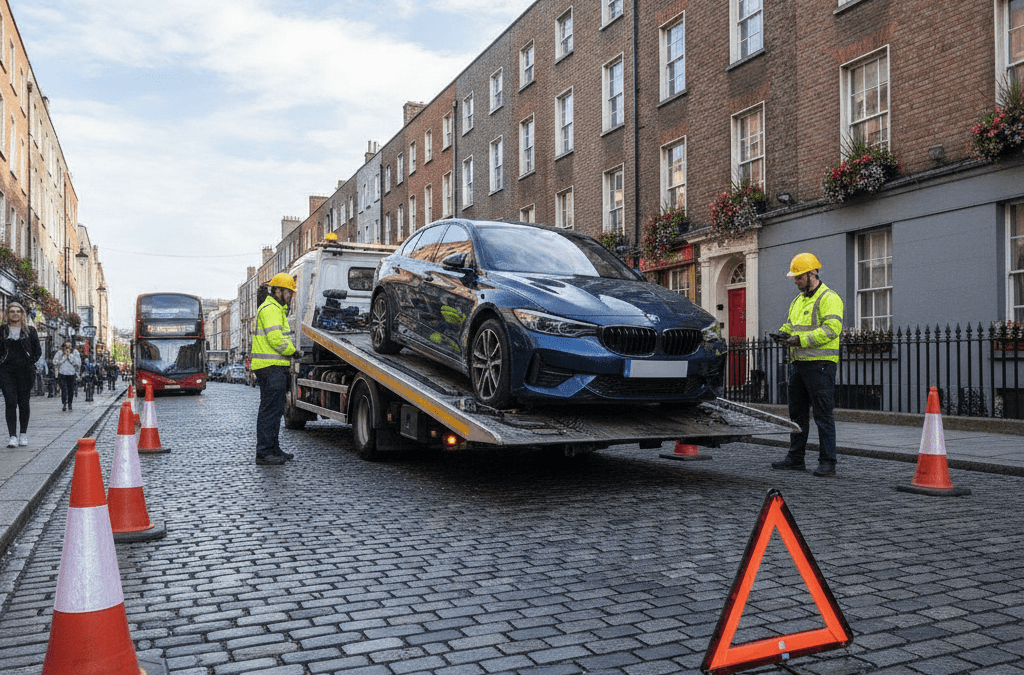
When a car stops moving, the first question most drivers ask is simple: “Can this be fixed here, or does it need to be towed?” In Dublin and across Ireland, car towing is used every day for breakdowns, accident recovery, non-starting vehicles, punctures without a safe spare, overheating engines, steering or braking faults, and cars that cannot legally or safely continue their journey. The process is usually straightforward, but it can feel stressful if you have never arranged recovery before.
This guide explains how car towing works, what affects the price, the difference between tow trucks and flatbeds, and what you should do before your vehicle is collected. It is written for everyday Irish motorists, whether you are stuck on the M50, parked in an underground car park in Dublin city, stranded outside work, or trying to move a non-running car from home to a garage.
The most important rule is safety first. If your car is in a dangerous place, do not attempt repairs at the roadside. Put on your hazard lights, move away from live traffic where possible, and call for help. If you are unsure whether you need towing or roadside help, our guide to breakdown recovery vs roadside assistance explains the difference in more detail.
What Is Car Towing?
Car towing is the process of moving a vehicle that cannot, should not, or must not be driven from one location to another. In practical terms, that might mean moving your car from the roadside to a garage, from your home to a repair workshop, from an accident scene to a storage yard, or from a car park to your chosen mechanic.
In Ireland, drivers often use the word “towing” for several types of recovery. Sometimes the car is pulled using a towing frame or lift. In other cases, it is fully loaded onto a flatbed recovery truck. The right method depends on the vehicle, the fault, the location, access, and safety risks.
Towing is not only for dramatic breakdowns. A vehicle may need transport if it has a flat battery and cannot be safely jump-started, a failed clutch, a snapped belt, a damaged wheel, a lost key, a coolant leak, an electrical fault, or a warning light that makes further driving risky. If the car cannot be safely repaired where it is, recovery is often the correct choice.
When Do You Need a Tow Instead of a Roadside Repair?
Not every breakdown needs towing. Some problems can be handled by roadside assistance or a mobile mechanic, especially if the vehicle is parked safely and the fault is minor. For example, a flat battery, a loose connection, a simple wheel change, or a basic diagnostic check may not require full recovery.
However, there are many situations where towing is the safer and more sensible option. You should strongly consider recovery if the vehicle has been in a collision, will not start after basic checks, has steering or braking problems, is leaking oil or coolant, is overheating badly, has heavy smoke, has suspension damage, or is stopped in a dangerous position. A useful roadside repair guide from TowNow makes the same practical point: avoiding a tow is only worthwhile when the vehicle and the location are safe enough for repairs to be attempted, and recovery is the better option when safety or serious mechanical damage is involved. You can read that advice here: roadside repairs a mobile mechanic can handle.
A good way to think about the decision is this: roadside assistance is for getting you moving when the issue can be solved safely on the spot; towing is for moving the vehicle when driving it would be unsafe, impossible, illegal, or likely to make the damage worse. If you want a more detailed comparison, see our explanation of when breakdown recovery is different from roadside assistance.
How the Car Towing Process Usually Works
Although every recovery job is slightly different, the general process follows a familiar pattern. Knowing what happens next can reduce stress and help the recovery operator bring the right equipment.
1. You Call and Share the Key Details
The first step is giving clear information. The operator will normally ask for your exact location, the vehicle make and model, whether the car is automatic or manual, whether it starts, whether it rolls, whether it has been in an accident, and where you want it brought. They may also ask about access issues such as low car parks, narrow streets, steep driveways, locked gates, or missing keys.
Good information matters. A small hatchback parked on a wide suburban road is very different from an automatic SUV stuck in a basement car park with no drive power. The more accurate you are, the easier it is to dispatch the right truck and avoid delays.
2. The Operator Assesses Safety and Access
Before the vehicle is moved, the recovery driver will assess the scene. On a busy road, their priority is protecting people and reducing risk. They may position the truck to create a safer working area, use warning lights, and ask you to stand clear while the vehicle is loaded.
If the car is in a tight space, the driver may need to use skates, winching equipment, wheel lifts, or careful manoeuvring. Some vehicles cannot be loaded in the normal way if the wheels are locked, the handbrake is stuck, the suspension has collapsed, or the keys are missing. These details can affect both the time required and the towing method.
3. The Vehicle Is Secured for Transport
Once the car is in position, it must be properly secured. This usually involves straps, wheel restraints, chains, or other approved securing equipment. A professional recovery operator will not simply “pull away” with a vehicle loosely attached. Secure loading protects your car, the recovery driver, other road users, and the truck itself.
4. The Car Is Delivered to the Chosen Destination
Most drivers choose a garage, home address, tyre centre, dealership, storage yard, or workplace. If your garage is closed, ask in advance whether the vehicle can be left safely, whether there is a key drop, and whether the recovery operator needs special instructions. If the vehicle is being delivered after hours, confirm the exact drop-off point before the truck leaves.
What Affects the Cost of Car Towing in Dublin and Ireland?
Towing prices vary because recovery jobs vary. A short local tow from a driveway to a nearby garage is usually simpler than collecting a damaged vehicle from a motorway at night. When asking for a quote, remember that the price is not just for distance; it also reflects time, access, risk, equipment, and vehicle type.
Distance from Collection to Drop-Off
Distance is one of the clearest pricing factors. A tow within the same part of Dublin will usually cost less than recovery from Dublin to another county. Long-distance towing involves more fuel, more driver time, and more truck availability. If you need transport across Ireland, it is helpful to give the exact Eircode for both collection and destination so the operator can estimate the route accurately.
Vehicle Size and Weight
A small car is generally easier to move than a large SUV, commercial van, electric vehicle, or heavily loaded vehicle. Weight affects the type of recovery truck required and how the vehicle is secured. If your car is modified, lowered, has damaged suspension, or carries extra equipment, mention it when booking.
The Type of Fault
A car that rolls freely and steers normally is usually easier to load than a vehicle with locked wheels, no keys, a seized handbrake, accident damage, or collapsed suspension. A non-starting car in neutral may be straightforward; an automatic stuck in park in an underground car park may require more specialist handling.
Battery problems are a common reason drivers consider towing, but a tow is not always necessary. If the car is parked safely, it may be worth checking whether the issue is simply a weak or failed battery. Battery Replacement Dublin has a helpful guide to signs a car battery is about to die, including symptoms such as slow cranking, clicking, dim lights, and repeated starting trouble. If the car cannot be revived safely or there is another fault, recovery may still be needed.
Location and Access
Where the vehicle is located can make a major difference. Towing from a quiet driveway is usually simpler than recovering a car from a multi-storey car park, a narrow city centre lane, a motorway hard shoulder, a muddy verge, or a steep underground ramp. Low clearance can prevent a standard recovery truck from entering some car parks, which may require alternative equipment or a different approach.
Time of Day and Urgency
Emergency recovery outside normal working hours may cost more than a scheduled daytime collection. Night work, weekends, bank holidays, and urgent call-outs can increase the price because of driver availability and operating costs. If your car is parked safely at home, booking a planned recovery may be more cost-effective than requesting immediate collection.
Special Equipment
Some jobs require winching, skates, dollies, low-angle loading, or specialist equipment for automatic, electric, classic, or damaged vehicles. These jobs can take longer and may need a particular type of truck. If your car cannot roll, cannot steer, has no keys, or is damaged underneath, say so before the truck is dispatched.
Tow Truck vs Flatbed: What Is the Difference?
Drivers often use “tow truck” and “flatbed” as if they mean the same thing, but there are important differences. The best choice depends on the vehicle and situation.
Traditional Tow Truck or Wheel-Lift Recovery
A traditional tow truck may lift one end of the vehicle while the other wheels remain on the road. This can be useful for certain vehicles and short recoveries, but it is not suitable for every car. Modern vehicles with automatic transmissions, all-wheel drive, electric drivetrains, low ride height, or serious wheel damage may need a different method to avoid further damage.
Wheel-lift towing can be efficient when used correctly, but the recovery operator must understand the vehicle’s drivetrain and manufacturer restrictions. If in doubt, ask whether your car should be fully lifted rather than towed with wheels on the ground.
Flatbed Recovery
A flatbed recovery truck carries the entire vehicle on the truck bed. This is often preferred for damaged vehicles, automatics, electric vehicles, prestige cars, 4x4s, cars with major wheel or suspension problems, and vehicles that should not rotate their wheels during transport. Because the car is fully off the road, flatbed transport reduces the risk of drivetrain or tyre damage during the journey.
Flatbeds are also useful for longer distances. If you are transporting a car across Dublin or to another county, a flatbed may be the most secure and practical option, particularly if the car is not roadworthy.
How to Prepare Your Vehicle for Collection
A little preparation can make towing faster, safer, and less stressful. Even if you are waiting at the roadside, there are several useful steps you can take while staying safe.
Make the Vehicle and Location Easy to Identify
Give the recovery operator an Eircode, nearby landmark, road name, direction of travel, junction number, or car park level. If you are on a motorway or dual carriageway, explain which side you are on and whether you are before or after a particular exit. In large housing estates or business parks, share a pin location if possible.
Remove Valuables and Personal Items
Before the car is transported, remove wallets, phones, laptops, documents, house keys, child seats if needed, toll tags, parking permits, medication, and anything fragile. If the vehicle is going to a garage after hours, you may not have access to it again until the next working day.
Have the Keys Ready
Keys make recovery much easier because the driver can release the steering lock, select neutral, disable the handbrake, and position the vehicle safely. If the keys are lost, tell the operator before booking. Keyless cars can also be awkward if the fob battery is dead or the vehicle does not recognise the key.
Do Not Keep Driving to “See If It Clears”
If your car is overheating, losing oil pressure, smoking heavily, misfiring badly, or showing a red warning light, continuing to drive can turn a repairable problem into serious engine damage. Stop in a safe place and arrange help. The same applies if braking or steering assistance changes suddenly. Getting the car towed may be far cheaper than causing major mechanical damage by driving on.
If the issue is a no-start problem, Mobile Mechanic 247 has a useful overview of common reasons a car will not start, from battery and starter issues to fuel and electrical faults. That type of information can help you describe the symptoms clearly when calling for assistance, even if the final decision is to recover the car.
Practical Examples: Which Towing Option Makes Sense?
Here are a few common Irish motoring scenarios and how towing decisions are usually made.
Example 1: Non-Starting Car at Home in Dublin
If your car will not start in the driveway, the safest approach is usually to diagnose the likely cause before arranging a tow. A flat battery, failed starter, immobiliser issue, or fuel problem can all cause similar symptoms. If the car can be fixed on-site, towing may be unnecessary. If it cannot be diagnosed or repaired where it is, a planned tow to your garage is normally straightforward because access is safer than a roadside breakdown.
Example 2: Puncture on a Busy Road With No Spare Wheel
Many modern cars have tyre inflation kits instead of spare wheels. If the tyre is badly damaged, the wheel is cracked, the locking wheel nut key is missing, or the location is unsafe, towing may be the best option. Driving on a flat tyre can damage the wheel, suspension, and braking components, so do not continue unless the vehicle is genuinely safe and roadworthy.
Example 3: Automatic Car Stuck in Park
An automatic vehicle that cannot be shifted into neutral may need specialist handling. It may not roll freely, and dragging it can cause damage. Tell the recovery company the car is automatic and stuck in park so they can bring suitable loading equipment.
Example 4: Car With NCT or Roadworthiness Concerns
If a vehicle is not roadworthy, has serious defects, or is being moved for inspection or repair, towing can be a safe way to transport it without driving. The official NCTS website explains that the NCT is Ireland’s compulsory vehicle inspection programme aimed at road safety and environmental protection. You can find official information at NCTS.ie. If your vehicle has a serious mechanical issue, do not assume it is safe to drive simply because the distance is short.
What to Ask Before Booking a Tow
Before confirming the booking, ask a few practical questions. What is included in the price? Is the quote based on the collection and destination you provided? Will the vehicle be moved by flatbed or another method? Can the operator handle automatics, electric vehicles, lowered cars, or locked vehicles if relevant? What is the estimated arrival time? Can they deliver to a closed garage or after-hours location?
You should also ask what happens if the job is more complicated than expected. For example, a car that was described as “not starting” may also have a seized wheel or blocked access. Clear communication helps prevent surprises and keeps the recovery process smooth.
Safety Tips While Waiting for Recovery
- Switch on your hazard lights as soon as it is safe to do so.
- Move away from live traffic, especially on motorways and dual carriageways.
- Do not stand between your vehicle and passing traffic.
- Avoid attempting repairs in a dangerous location.
- Keep your phone charged and stay contactable.
- Have your destination address and keys ready.
- If you feel unsafe, tell the recovery operator immediately and contact emergency services if necessary.
If you are weighing up whether a roadside fix is enough or whether the vehicle should be transported, return to the basic question: can the vehicle be made safe where it is? If not, professional breakdown recovery is usually the better choice.
Conclusion: Towing Is About Safety, Not Just Transport
Car towing in Dublin and across Ireland is not simply about moving a broken-down vehicle from A to B. It is about choosing the safest, most practical way to deal with a car that cannot continue under its own power. The cost depends on distance, vehicle type, access, urgency, equipment, and the nature of the fault. The right method may be a wheel-lift truck, a flatbed, winching equipment, or another recovery solution.
As a driver, the best things you can do are stay safe, give accurate information, avoid driving a vehicle that may be dangerous, remove your valuables, and confirm the destination before collection. If the issue can be repaired safely where the car is, roadside assistance may be enough. If the vehicle cannot be driven without risk, towing is the sensible option.
Whether your car is stuck at home, stopped on the roadside, stranded in a car park, or needs transport to a garage, understanding the towing process helps you make calm, informed decisions when a breakdown happens.